백신은 감염병 예방의 초석으로, 선천 면역을 촉발하고 항원 제시 세포(APC)를 자극해 특정 병원체에 대한 적응 면역 반응을 유도합니다. 보조제는 백신의 핵심 첨가물로서 면역 반응을 증폭·조절·지속시켜 백신 효과를 크게 높여 줍니다. WIXBIO 백신 보조제의 역사, 기전, 유형, 적용 사례, 최신 발전 동향을 살펴보고, 인체 및 동물용 백신 의 실제 사례를 함께 다루어 개발과 사용에 대한 과학적 지침을 제공합니다.
1. 백신 보조제의 역사
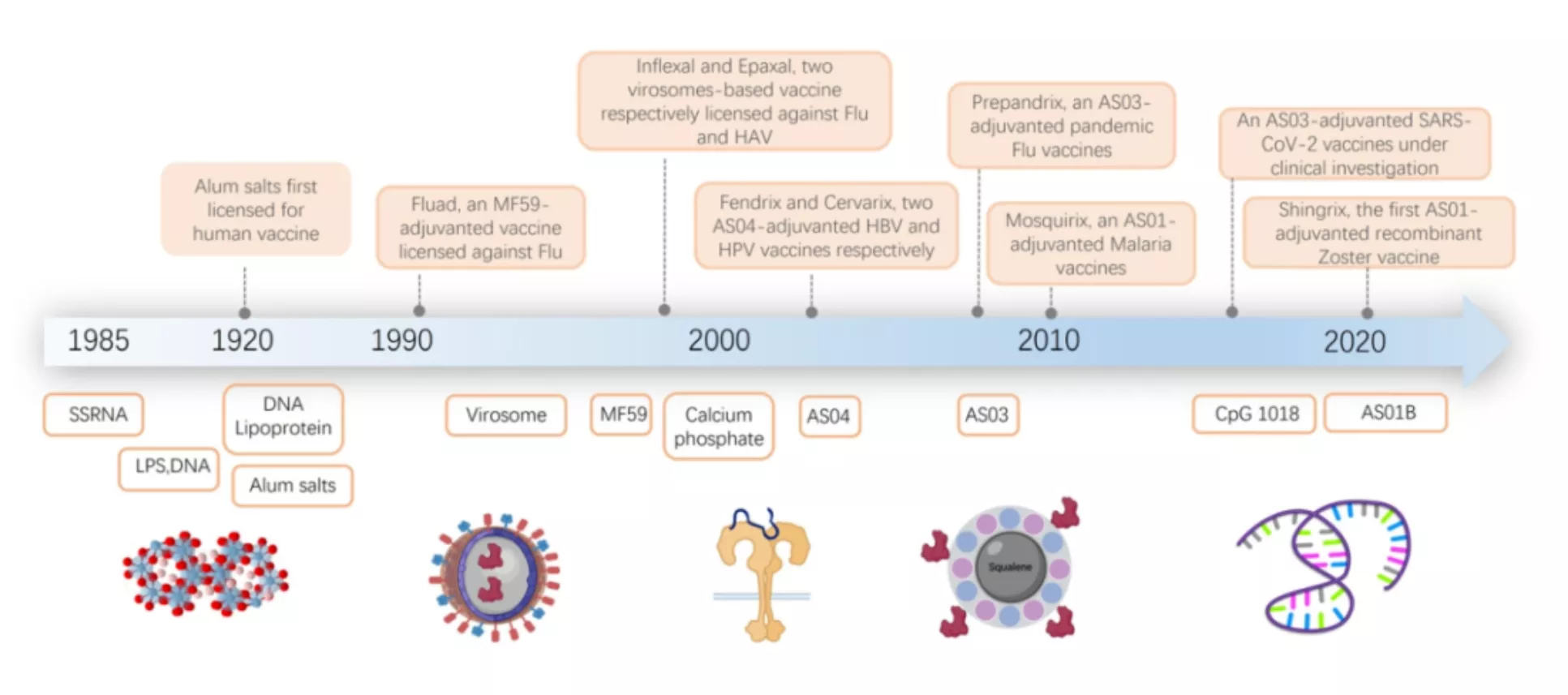
보조제 연구는 초기 정제 항원의 낮은 면역원성을 해결하기 위해 20세기 초에 시작되었습니다. 주요 이정표는 다음과 같습니다:
- 1920년대: 알루미늄염(수산화알루미늄, 인산알루미늄)은 최초의 인체용 백신 보조제로 디프테리아 및 파상풍 백신에 사용되며 보조제 활용의 토대를 마련했습니다. 또한 다음과 같은 동물용 백신에도 널리 사용됩니다: 불활화 조류 인플루엔자 백신.
- 1990년대: 수중유형 에멀전 보조제(예: MF59)가 인체 인플루엔자 백신(예: Fluad)과 동물용 뉴캐슬병 백신, 항원의 서방출과 선천 면역 활성화를 가능하게 했습니다.
- 2000년대: AS03(스쿠알렌 + α-토코페롤)과 AS01(리포좀 + 모노포스포릴 리피드 A) 같은 신규 보조제가 인체 H1N1 인플루엔자, 말라리아(RTS, S), 대상포진(Shingrix) 백신은 물론 동물용 돼지열병 백신에도 승인되었습니다.
- 2010년대~현재: TLR9 agonists (e.g., CpG-1018) were approved for human hepatitis B vaccines (Heplisav-B) and veterinary foot-and-mouth disease (FMD) vaccines, with nanotechnology and molecular biology driving the development of adjuvants.
Challenges: Aluminum salts, used for over 70 years, aren’t fully understood; novel adjuvants require further safety and tolerability validation, especially in veterinary vaccines where cost and scalability are critical.
참고문헌: O’Hagan et al., Nature Reviews Drug Discovery (2020); Veterinary Immunology and Immunopathology (2023).
2. 보조제의 이점과 효과
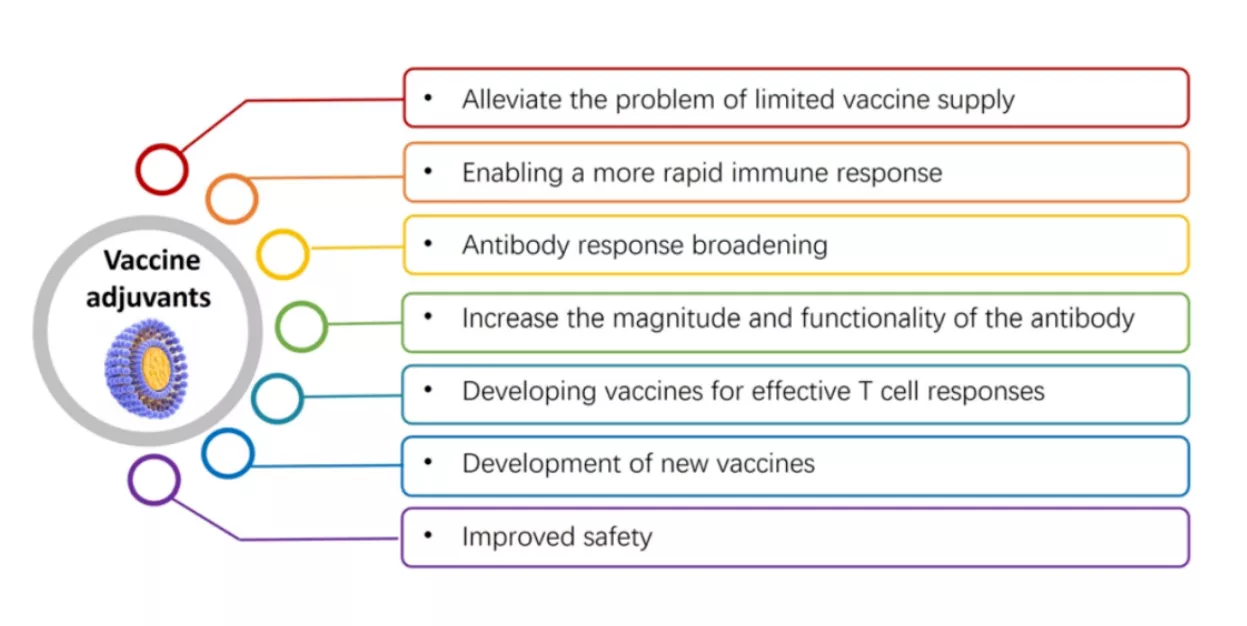
Adjuvants optimize immune responses, significantly boosting vaccine effectiveness in both human and veterinary fields:
- Dose Optimization: Enhances immune responses, reduces antigen requirements, and eases supply pressures. For example, AS03 cuts H1N1 vaccine doses by 50%, while MF59 reduces avian influenza vaccine antigen needs by 30% in veterinary use.
- 신속 대응: Accelerate antibody production, shortening protection time, making it ideal for emergency responses, such as veterinary Newcastle disease vaccines.
- Broad-Spectrum Protection: Widen antibody response range to address antigen-drift pathogens (e.g., influenza, feline leukemia virus).
- Enhanced Antibody Function: Increase antibody affinity and functionality, extending protection duration, notably in poultry bursal disease vaccines.
- T-Cell Activation: Induce balanced Th1/Th2 or CD8+ T-cell responses, improving clearance of intracellular pathogens (e.g., Marek’s disease virus in chickens).
- New Vaccine Development: Support the development of vaccines for diseases where traditional vaccines are ineffective (e.g., human malaria, poultry infectious bronchitis).
- Improved Safety: Lower antigen doses reduce the risk of adverse reactions, such as injection-site inflammation, in veterinary vaccines.
사례 연구: Shingrix vaccine with AS01 adjuvant achieves 97% protection against shingles. In veterinary use, CpG adjuvants in FMD vaccines double antibody titers and extend protection to 6 months.
3. 보조제의 유형과 기전
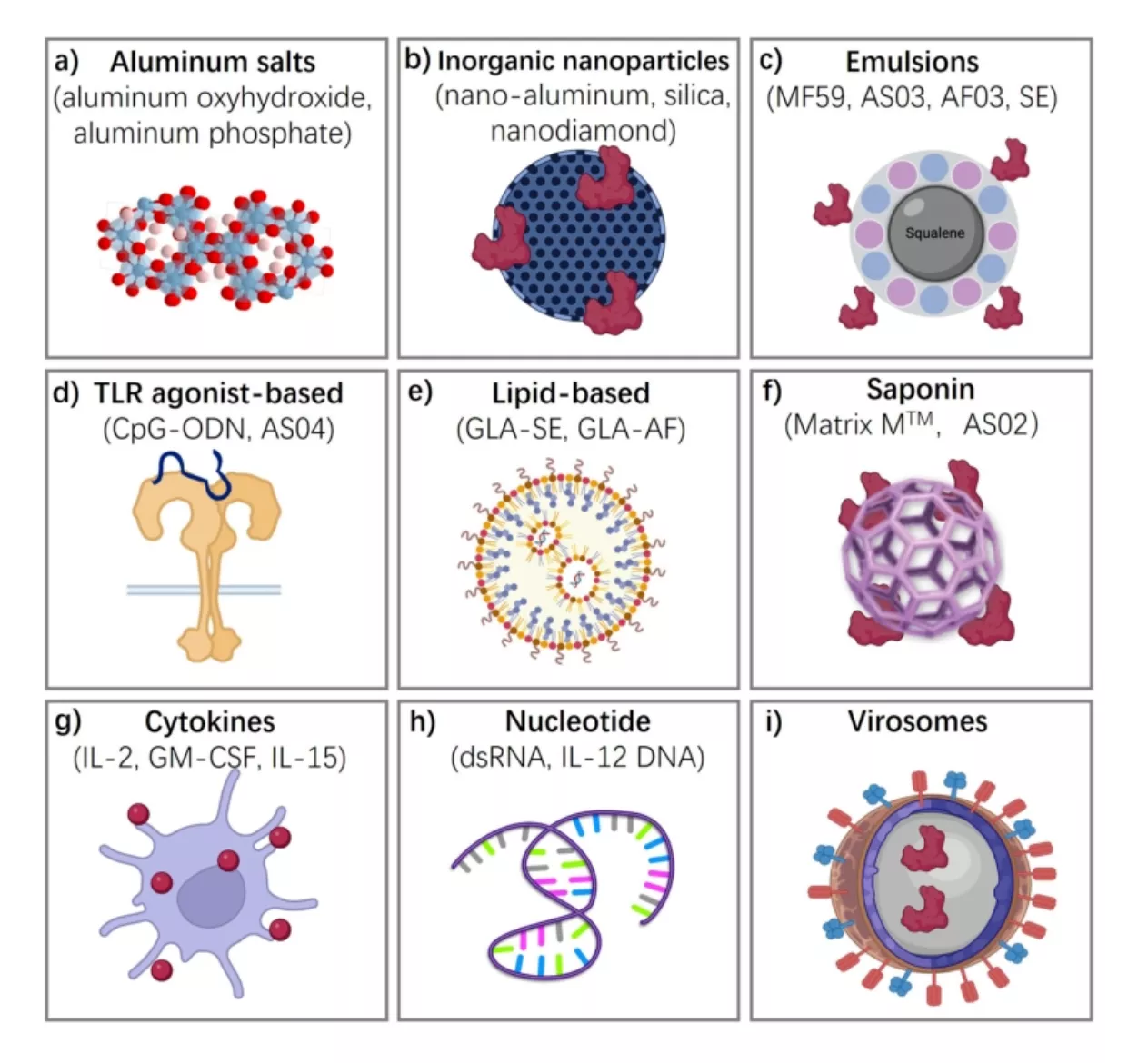
1. 알루미늄 기반 보조제
- 구성: 수산화알루미늄, 인산알루미늄 또는 이들의 혼합물.
- 작용 기전: 항원 저장소를 형성해 서서히 방출되도록 하고, 국소 염증을 유발하여 APC와 T세포를 활성화합니다.
- 적용 분야: 사람 B형 간염, HPV 백신; 동물용 조류 인플루엔자, 돼지 써코바이러스 백신.
- 한계: 주로 Th2 반응을 유도해 세포성 면역에는 효과가 떨어지며, 동물용 백신에서는 국소 부종을 일으킬 수 있습니다.
2. 에멀전 보조제
- 유형:
- MF59: 스쿠알렌 + 폴리소르베이트 80으로, ATP 방출과 사이토카인 발현을 유도하며 사람 인플루엔자 및 동물용 뉴캐슬병 백신에 사용됩니다.
- AS03: 스쿠알렌 + α-토코페롤로, 선천 면역을 활성화하며 사람 H1N1 및 동물용 돼지열병 백신에 사용됩니다.
- 작용 기전: 오일상이 항원을 둘러싸 노출 시간을 늘리고 체액성 및 세포성 면역을 자극합니다.
- 장점: 고령의 사람과 어린 동물의 면역 반응을 증강시킵니다.
3. 무기 나노입자 보조제
- 유형: 나노알루미늄, 층상 이중수산화물(LDH), 나노실리카.
- 작용 기전: 항원 운반체로 작용해 APC에 효율적으로 전달하고, 국소 염증을 유발해 면역 기억을 촉진합니다.
- 적용 분야: 사람 암 백신 연구; 동물용 구제역, 가금 전염성 F낭병 백신.
- 잠재력: 동물 실험에서 항체 역가가 2~3배 더 높게 나타났습니다.
4. TLR 작용제
- 예시: CpG-1018(TLR9 작용제)은 Th1 반응과 세포독성 T세포를 활성화합니다.
- 작용 기전: 패턴 인식 수용체를 자극해 MHC와 CD40 발현을 높이고 항원 처리를 촉진합니다.
- 적용 분야: 사람 B형 간염 백신; 동물용 소 바이러스성 설사 백신.
5. 리포좀 보조제
- 구성: Phospholipids + cholesterol, encapsulating antigens and immunostimulatory molecules.
- 작용 기전: Target dendritic cells, inducing Th1-biased responses, ideal for complex pathogens.
- 적용 분야: Human malaria, shingles vaccines; veterinary Marek’s disease vaccines.
6. 기타 보조제
- Cytokines, such as IL-12, enhance immune signaling and have been tested in veterinary pseudorabies vaccines.
- Polymers: Slow-release antigens, prolonging immune stimulation, researched for poultry vaccines.
- Saponins: E.g., QS-21, activate APCs, used in AS01 systems (human shingles, veterinary swine fever vaccines).
- Virosomes: Mimic viral structures, boosting immunogenicity, tested in avian influenza vaccines.
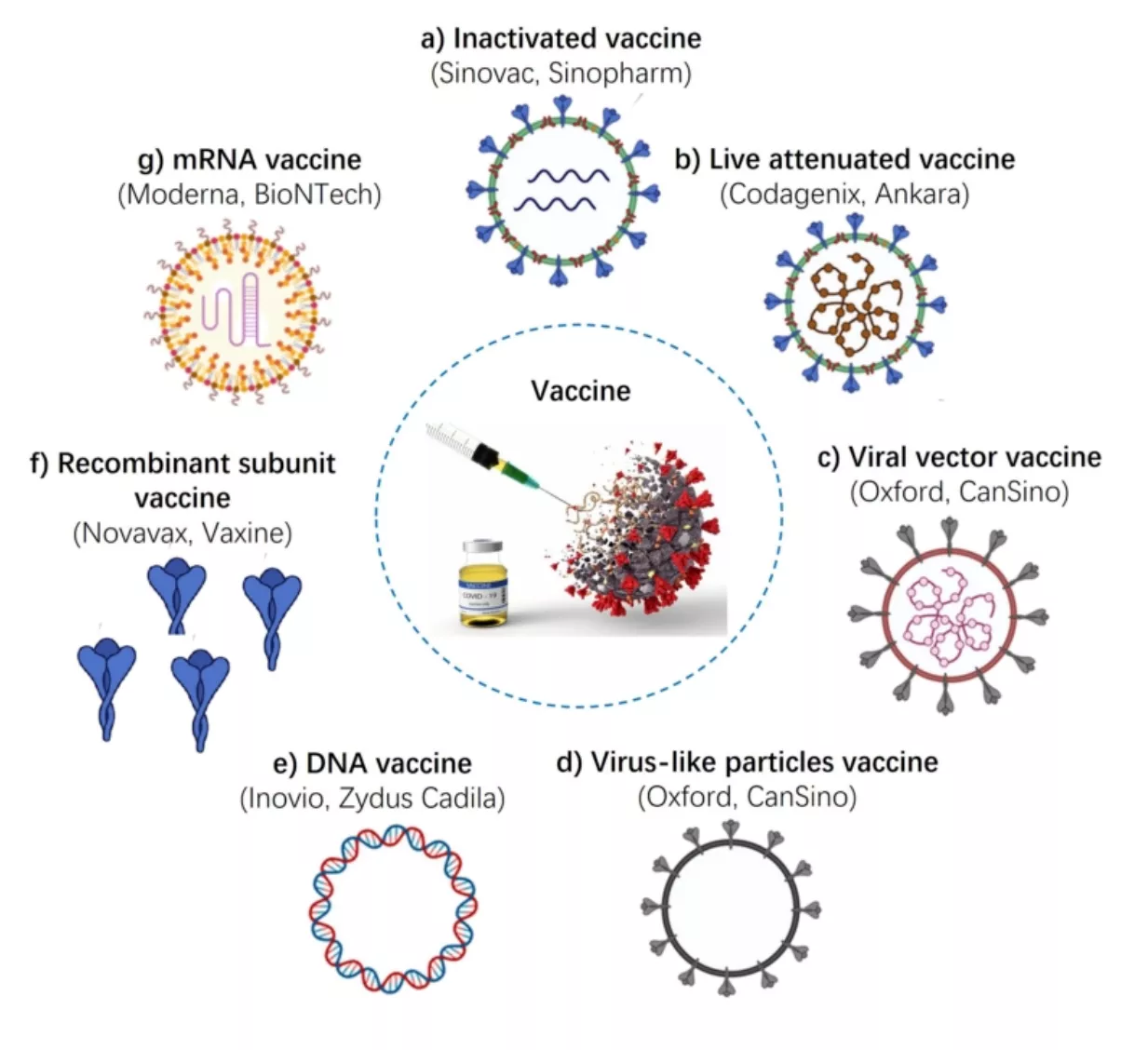
4. 백신 유형별 보조제 적용
| 백신 종류 | Common Adjuvants | Example Vaccines | 특징 |
|---|---|---|---|
| 불활화 | Aluminum, MF59, AS03 | Human H1N1 influenza, veterinary avian influenza | Enhances antibody response |
| Live Attenuated | Usually none | Human influenza, veterinary Newcastle disease | Strong inherent immunogenicity |
| Viral Vector | AS03, CpG | Human COVID-19, veterinary FMD | Boosts T-cell and antibody responses |
| Virus-Like Particles | Aluminum, MF59, CpG | Human HPV, veterinary porcine circovirus | Mimics virus structure for strong immune response |
| DNA Vaccines | Aluminum, CpG, liposomes | Experimental vaccines | Improves immunogenicity |
| mRNA Vaccines | Usually none | Human COVID-19, veterinary experimental vaccines | Exploring adjuvants for elderly animals |
| Protein Subunit | Aluminum, MF59, AS04 | Human shingles, veterinary bursal disease | Enhances antibody affinity and duration |
Veterinary Case Study: In inactivated avian influenza vaccines, MF59 adjuvant boosts antibody titers, increasing protection rates from 60% to 90% and reducing antigen use by 20%.
5. 보조제 개발의 발전
1. 설계 원칙
- Immune Needs: Target specific immune responses (e.g., Th1 for intracellular pathogens, Th2 for humoral immunity).
- Targeted Delivery: Design systems to target APCs (e.g., dendritic cells, macrophages).
- Safety: Balance immune stimulation with inflammation, minimizing injection-site reactions (critical for veterinary vaccines).
- Production Ease: Ensure scalability for human and veterinary vaccine cost requirements.
2. 신규 보조제 제형
- AS01: MPL + QS-21 synergy, boosting Th1 responses, achieving 97% protection in human shingles vaccines, and extending veterinary swine fever vaccine protection to 8 months.
- Nano-Adjuvants: Nanosilica in avian influenza vaccines increases antibody levels threefold, with animal studies demonstrating a 6-month extension of immune memory.
- Combination Adjuvants: TLR agonists + liposomes, targeting complex pathogens (e.g., human HIV, veterinary poultry infectious bronchitis).
3. 시스템 백신학
- 방법: Use transcriptomics and proteomics to analyze adjuvant mechanisms and optimize formulations.
- 적용 분야: Predict adverse reactions and guide precise delivery. For example, systems vaccinology optimized CpG formulations in bovine viral diarrhea vaccines, resulting in a 10% reduction in inflammation.
4. 비침습적 백신 전달
- Technologies: Develop transdermal, nasal spray, or oral adjuvant delivery systems to reduce administration challenges, making them ideal for large-scale veterinary vaccination.
- Prospects: Reverse vaccinology and next-generation sequencing facilitate the development of broad-spectrum vaccines for human HBV and veterinary feline leukemia.
Veterinary Case Study: Nasal Spray Newcastle Disease Vaccines with Nano-Adjuvants Cut Immunization Time by 50%, Achieving 95% Protection, Ideal for Large-Scale Farms.
6. 동물용 보조제 선택 시 특별 고려사항
Choosing adjuvants for veterinary vaccines involves extra factors:
- Cost Control: Veterinary vaccines must be economical for large-scale farming; nano-adjuvants and liposomes need optimized production.
- Species-Specificity: Immune responses vary across species (e.g., poultry, pigs, cattle), requiring tailored formulations. Chickens respond strongly to TLR3 agonists, while pigs favor TLR9 agonists.
- Environmental Factors: Farm conditions are complex; adjuvants must withstand high temperatures and humidity to avoid emulsion breakdown or degradation.
- Adverse Reactions: Minimize injection-site swelling (common with aluminum adjuvants) through warming and proper handling (as detailed in 가금류 백신의 올바른 사용 및 보관).
7. 결론
Adjuvants are a driving force behind vaccine success, boosting immunogenicity, optimizing doses, and broadening protection for human and veterinary vaccines. Advances in nanotechnology, systems vaccinology, and non-invasive delivery will push adjuvants toward greater safety, efficacy, and versatility. Precise adjuvant-antigen pairings, combined with research into molecular mechanisms, will provide new strategies to address global health challenges such as COVID-19 and avian influenza. In veterinary applications, optimized adjuvants will further reduce farming costs while improving animal health and food safety.
참고문헌:
- O’Hagan DT, et al. The history and future of vaccine adjuvants. Nature Reviews Drug Discovery, 2020.
- WHO, Vaccine Adjuvant Safety Guidelines, 2023.
- Pulendran B, et al. Systems vaccinology: enabling rational vaccine design. Nature Reviews Immunology, 2021.
- Veterinary Immunology and Immunopathology, Special Issue on Adjuvants, 2023.